
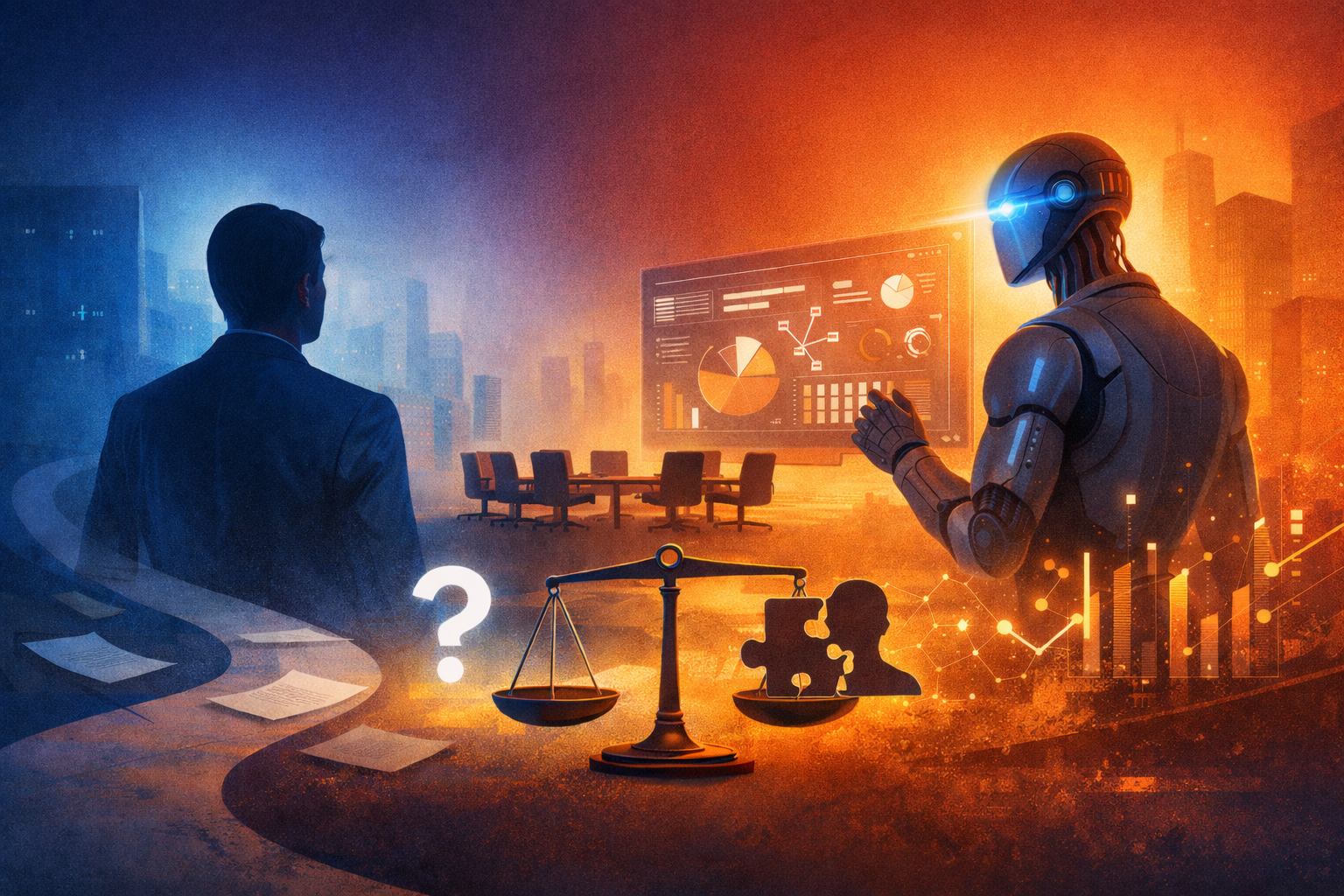
The loudest fear about AI is that it will replace us.
But that fear is distracting leaders from something far more dangerous—and far more common.
The real risk isn’t replacement.
It’s abdication.
Not the dramatic kind.
The quiet kind that sounds reasonable, efficient, even responsible.
- “Let the system decide.”
- “The data says this is the best option.”
- “AI already optimized it.”
No one resigns.
No one announces they’re stepping back.
Leadership just…thins out.
When Authority Shifts Without Anyone Noticing
AI doesn’t demand authority.
We hand it over—one small decision at a time.
First it’s scheduling.
Then prioritization.
Then performance signals.
Then judgments about risk, value, and relevance.
Each step feels harmless. Logical. Modern.
Until leaders find themselves managing outcomes they no longer fully understand—and defending decisions they didn’t actually make.
This is how abdication happens:
Not through laziness or incompetence, but through unexamined trust.
And here’s the uncomfortable truth:
AI doesn’t replace leadership—it reveals where leadership has already gone missing.
Efficiency Is Not the Same as Responsibility
AI is excellent at optimization.
Leadership is not about optimization.
Leadership lives in places AI can’t occupy:
- Ambiguity
- Tension
- Moral tradeoffs
- Human impact that can’t be quantified
When leaders default to AI outputs without staying present to these tensions, something subtle breaks.
Not performance.
Not speed.
Responsibility.
And once responsibility is outsourced, you’re still in charge on paper—but not in practice.
You still have the title.
You still run the meetings.
But the center of gravity has shifted elsewhere.
The Seduction of “Objectivity”
One of AI’s most convincing qualities is how neutral it appears.
No tone.
No emotion.
No personal stake.
For leaders tired of conflict or second-guessing, that neutrality feels like relief.
But neutrality is not wisdom.
AI reflects the assumptions it’s trained on—and the ones leaders stop questioning.
When leaders treat AI as an objective authority, they’re not removing bias.
They’re hiding it behind a machine.
And that’s how abdication disguises itself as professionalism.
What Abdication Looks Like in Real Life
Abdication doesn’t look like leaders disappearing.
It looks like leaders deferring.
- Decisions justified with “the model recommends” instead of “here’s how I thought this through.”
- Conversations shut down by dashboards instead of opened by inquiry.
- Leaders protecting themselves with process instead of standing inside consequence.
Over time, teams feel it.
Trust thins.
Judgment weakens.
People stop bringing nuance—because nuance no longer has a place to land.
AI Can’t Carry What Leadership Refuses to Hold
AI cannot:
- Stand in front of a human cost
- Repair a rupture
- Decide what matters when values collide
- Be accountable when the answer harms someone
Those are not bugs.
They’re not missing features.
They are the work.
And when leaders quietly step away from that work, AI doesn’t fail.
Leadership does.
This Is the Real Question Leaders Face
The question isn’t “How do I use AI better?”
It’s this:
Where am I tempted to let AI decide so I don’t have to stay inside the discomfort of leading?
That’s the edge.
Not technology.
Not tools.
But the willingness to remain present when there is no clean answer.




.png)